Hard wax vs soft wax: the difference, when to use each, and where sugar wax fits
Quick answer: hard wax sets into a film that is peeled off without a strip and grips mainly the hair, so it wins on face, underarm, bikini and Brazilian work and on short or coarse hair. Soft wax is spread thin and removed with a strip, so it wins on legs, arms and back where speed over a large area matters. Sugar wax is a water-soluble paste worked by hand. Most salons run hard and soft wax side by side.
The difference in one paragraph
Hard wax is melted, spread thick, left to set into its own flexible film, and peeled off by hand with the hair locked inside it. Soft wax is spread thin and stays soft; a cloth or paper strip is pressed on top and pulled, taking the wax and the hair with it. That single difference, film versus strip, decides where each one wins.
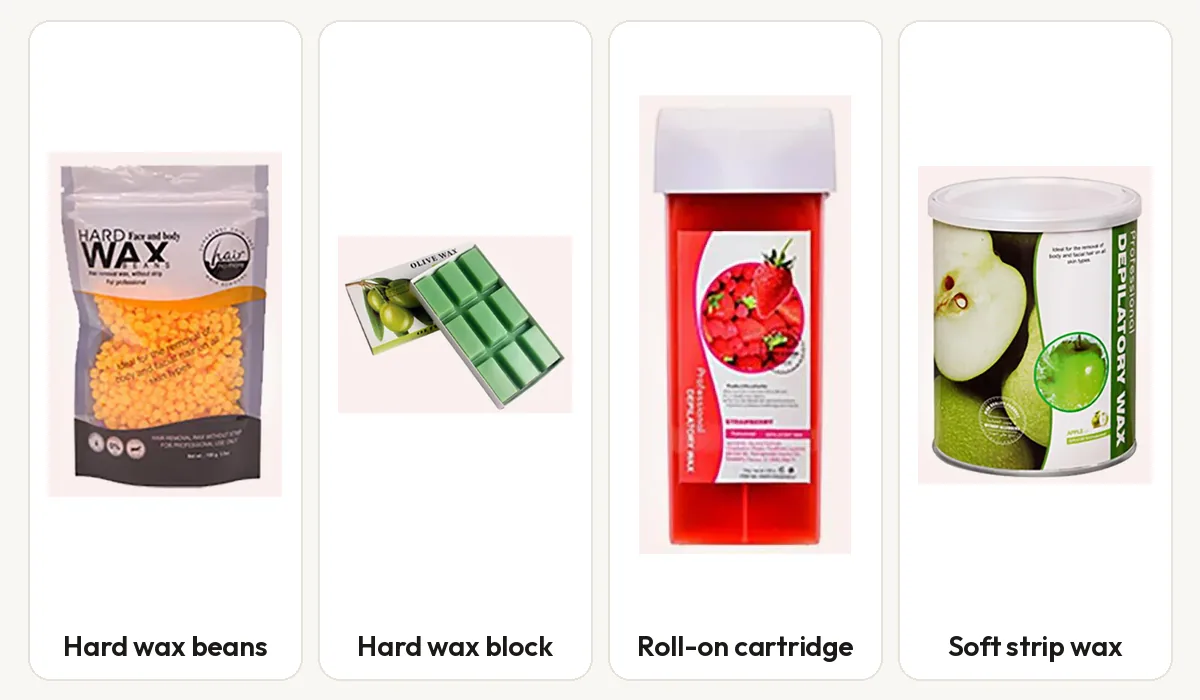
Hard wax vs soft wax side by side
| Hard wax | Soft wax | |
|---|---|---|
| Removal | Sets into a film, peeled off directly, no strip | Stays tacky, removed with a cloth or paper strip |
| Application | Thick, coin-like layer with a lip to pull from | Thin, even layer with a spatula or roller |
| What it grips | Mostly the hair; it shrink-wraps the hair as it sets | Hair and the surface layer of skin |
| Where it wins | Face, underarm, bikini and Brazilian, short or coarse hair | Legs, arms, back, chest: large flat areas |
| Speed on large areas | Slower, worked in sections | Fast, one strip covers a lot of skin |
| Going over an area twice | Usually tolerated, because it lifts less skin | Avoided on the same patch |
| Consumables | Wax and applicators | Wax, applicators and strips |
| Formats | Beads (beans), blocks, discs | Cans, tins, roll-on cartridges |
When hard wax is the better choice
- Intimate areas. Bikini line and Brazilian are where hard wax earned its name in salons: the film grips coarse hair and releases from delicate skin without a strip.
- Face and brows. Small, precise shapes, and a material that lifts less skin on thin facial skin.
- Underarms. Hair grows in more than one direction; hard wax can be laid in small sections that follow it.
- Short or coarse hair. The thick layer wraps hair that a thin strip wax would skate over.
- Sensitive skin. Many practitioners reach for hard wax on reactive clients because it sticks mainly to hair. That is a working preference, not a medical claim; patch test, and read the ingredient list, since most professional hard waxes are rosin-based.
When soft wax is the better choice
- Legs, arms, back and chest. One strip covers a large area in a single pull, which is what keeps a leg wax inside its booking slot.
- Fine hair over large areas. A thin layer and a strip pick up fine body hair efficiently.
- Roll-on and at-home kits. Soft wax in a 100g cartridge with a handheld heater is the easiest format for a beginner to keep clean.
That is why most salon menus run both: hard wax for detail and intimate work, soft wax for the big areas. The question for a salon is rarely which wax, more often which wax for which service.
Where sugar wax fits
Sugaring uses a paste of sugar, water and lemon juice worked by hand, usually at close to body temperature, and flicked off in the direction of hair growth. It is water-soluble, so residue washes off, and it suits clients who prefer a paste without resins. The trade-offs are technique (sugaring has a learning curve of its own) and grip on very coarse hair, where hard wax is usually quicker. Hard wax vs sugar wax is therefore less a contest than two different crafts; a salon that offers both is selling two services.
| Method | Removal | Clean-up | Typical use |
|---|---|---|---|
| Hard wax | Film peeled off, against growth | After-wax oil | Face, underarm, bikini, Brazilian |
| Soft wax | Strip pulled, against growth | After-wax oil | Legs, arms, back |
| Sugar wax | Paste flicked off, with growth | Water | Clients who prefer a water-based paste |
Film wax, stripless wax and hard wax
Film wax, stripless wax and hot film wax are other names for hard wax. Some brands use film wax for formulas built with synthetic polymers that set more flexibly and work at a lower temperature; others use the words interchangeably. On a datasheet, compare the working temperature, set time and flexibility, not the name on the bag. What the formulas are made of is covered in what hard wax is made of.
Stocking both: what a salon or shop actually orders
- Hard wax beads in two or three colourways, one for face and sensitive work, one for body.
- A 500ml pot for the beads, and a 200ml pot if facial work runs at its own setting.
- Soft wax in 800ml cans for a pot, or 100g roll-on cartridges with a handheld heater.
- Applicators, strips for the soft wax, pre-wax spray and after-wax oil.
Buying the two waxes and the warmers from one source keeps melt behaviour predictable across the menu, and it is one carton instead of four suppliers.
Questions people ask
Is hard wax or soft wax better?
Neither in general. Hard wax is better for face, underarm, bikini and Brazilian work and for short or coarse hair; soft wax is better for legs, arms and back because one strip covers a large area. Most salons use both.
Is hard wax less painful than soft wax?
Many clients find hard wax more comfortable on sensitive areas because it grips mainly the hair and lifts less skin. Pain also depends on technique, hair length and how taut the skin is held, so the practitioner matters as much as the wax.
Do you need strips with hard wax?
No. Hard wax sets into its own film and is peeled off by hand. Strips are used only with soft wax.
Can you use soft wax for a Brazilian?
Some practitioners do, but most professionals use hard wax for Brazilian and bikini services because it grips coarse hair and releases from delicate skin without a strip, and the area can be worked in small sections.
What is the difference between hard wax and sugar wax?
Hard wax is a resin-based wax melted in a pot and peeled off against hair growth; sugar wax is a sugar, water and lemon paste worked by hand at close to body temperature, flicked off with hair growth and cleaned up with water. Hard wax is usually quicker on coarse hair; sugaring suits clients who prefer a water-based paste.
Is film wax the same as hard wax?
Yes, film wax and stripless wax are names for hard wax. Some brands use film wax for more flexible, lower-temperature formulas; compare datasheets rather than names.
Where this leads on our side
Both waxes are on our stock list. The hard wax beads come in 24 colourways from 100g to 1000g; soft wax in cans and tins and the roll-on format are on the full range page, and the pots and heaters that melt each one ship in the same carton. Starting a menu from scratch? A complete kit puts the warmer, beads, applicators and aftercare in one box. For the technique itself, see how to use hard wax beads.
Stocking both waxes?
Hard wax beads in 24 colourways, soft wax in cans and cartridges, and the warmers for each, in one carton. Prices the same working day, stock ships in 3 days.