How to launch your own hard wax brand
Quick answer: pick one or two hero formats (usually beans), start from a proven stock formula with your own label and packaging, order the smallest run your manufacturer can produce, and spend the money you saved on samples and listing quality. Custom colour and fragrance belong in the reorder, after the market has told you what sells.
Who this guide is for
Estheticians and studio owners who want their own retail line, and Amazon or TikTok Shop sellers building a waxing kit brand. It assumes you are starting from low volume and need each decision to be reversible.
If you are an established brand switching factories, your process is different: you will want batch records and comparative testing against your current supplier before anything else. This guide is about starting from zero.
Hard vs soft vs film: know what you are selling
Every wax product on the market is one of three working styles, and your customers search for them differently.
| Type | How it works | Best for | Formats |
|---|---|---|---|
| Hard wax (stripless) | Applied warm, sets into a flexible film, peeled off directly | Face, underarm, bikini, sensitive areas | Beans, blocks, discs |
| Soft wax (strip) | Applied thin, removed with a paper or cloth strip | Legs, arms, large areas, speed work | Cans, tins, roll-on cartridges |
| Film wax | A hard wax variant drawn into a thinner, more elastic film | Practitioners who want faster set and flexible technique | Beans, discs |
Beans dominate the retail and at-home market because they are easy to dose into a warmer and photograph well in packaging. That is why most new brands lead with beans and add roll-on or soft wax as line extensions.
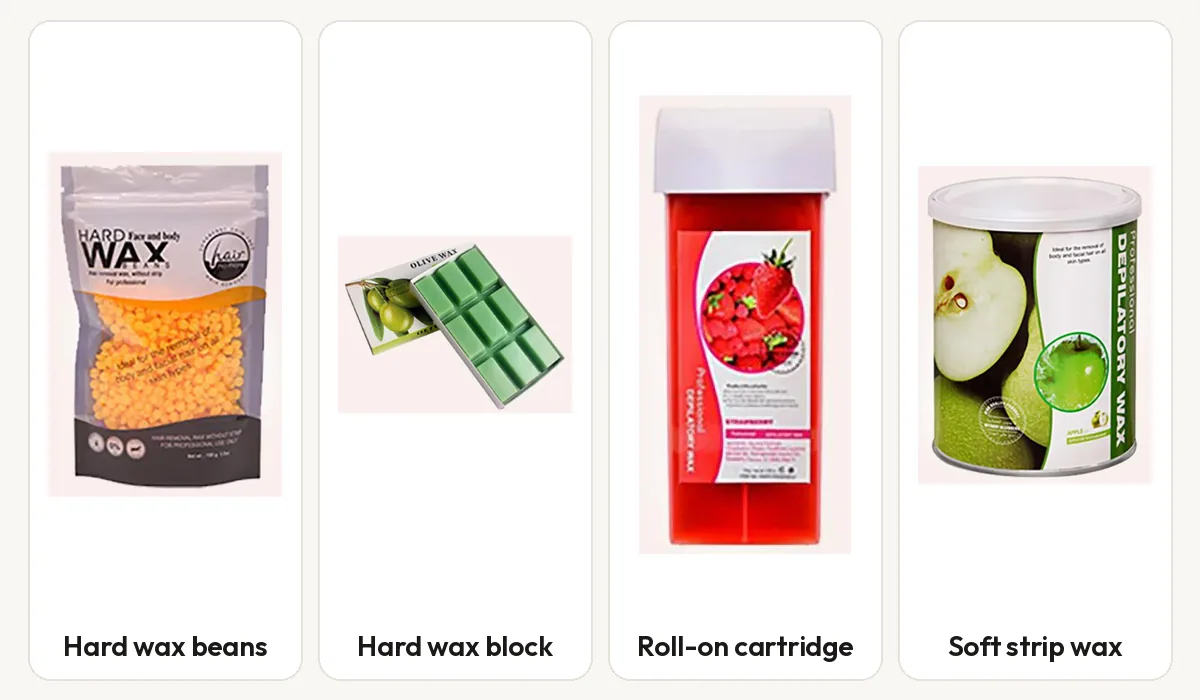
Choosing a formula
The professional baseline is a rosin-based system. Rosin and its esters are the grip mechanism: they are what makes the film lock onto coarse hair and release from skin. When a listing advertises itself with vague "no-rosin" language, it is usually swapping the industry-standard grip system for something the buyer cannot evaluate.
What actually matters when you evaluate a sample:
- Working temperature. It should spread comfortably soon after melting, without a long cool-down wait.
- Set time. Too fast frustrates beginners, too slow kills salon throughput. Decide who your buyer is first.
- Peel behaviour. The film should come off in one piece at body temperature, without shattering or stringing.
- Residue. Skin should finish clean, without a sticky film that needs solvent.
- Scent through heat. Fragrance smells different at 40 degrees than in the bag. Melt the sample before judging it.
Test on real hair, not just the back of your hand. If you run a studio, your next ten clients are your test panel.
Packaging formats and what they signal
- Stand-up bags (100g to 1000g). The marketplace default. Cheapest to print, light to ship, and the 100g size makes a natural trial listing.
- Bottles (400g, 1000g). Read premium on a shelf and protect beans from crushing in transit. Good for brand-led positioning.
- Jars. Scoop-friendly for salon counters.
- Trays and tubes. Blocks and discs for salon-side melting, a professional signal in a line-up.
- Kits. Wax plus warmer plus applicators plus aftercare in one box. Kits raise average order value and are the format most first-time buyers actually search for.
The four cost drivers
Quotes vary for reasons that are structural, not arbitrary. Four things move your unit cost:
- Formula customisation. Stock formula with your label is the cheapest entry. Custom colour or fragrance adds development and batch-size requirements.
- Packaging complexity. A printed stock bag costs less than a custom bottle with a custom cap. Every new tooling or print process adds setup cost.
- Order size. Bigger runs amortise setup. This is why the reorder is where private label margins improve.
- Freight mode. Courier for samples, air for launches on a deadline, sea for economics. A transport classification that confirms non-restricted goods keeps all three lanes open.
Budget honestly by getting a quote for your exact mix instead of extrapolating from a competitor's guessed numbers.
MOQ reality
MOQ is not a wall, it is a curve. The practical version:
- Your label on stock product starts lowest, because the factory is only changing the print.
- Custom colour or fragrance requires a minimum batch of that formula, so MOQ steps up.
- Custom packaging adds the print or tooling minimum of the packaging supplier on top.
Two honest rules. First, ask for the MOQ of your exact configuration before you fall in love with it. Second, if a factory quotes an MOQ far below everyone else for a fully custom product, ask what corner is being cut, because something is.
Compliance basics by market
Depilatory wax is generally regulated as a cosmetic. The pattern in the three biggest English-speaking markets:
- United States. Cosmetics are not pre-approved by the FDA. Under MoCRA, manufacturing facilities register with the FDA and products are listed; labelling rules limit what you can claim. The FDA does not endorse cosmetics at all, so any listing advertising an FDA endorsement is a red flag.
- European Union. Cosmetic products need a Responsible Person in the EU, a product information file, and notification through the CPNP portal before sale.
- United Kingdom. Post-Brexit, the UK runs its own notification (SCPN) with a UK Responsible Person.
Whatever market you sell into, three questions for any supplier: can you show a current MSDS, what is your FDA or notification status in plain words, and is the transport classification current. A supplier who answers with document numbers is safer than one who answers with badge graphics. Our own current status is published on the compliance page. Confirm the requirements for your specific product and market with a regulatory professional; this guide is orientation, not legal advice.
The launch workflow
- Define the line-up. Formats, weights, flavours, kit or no kit. Narrow beats broad at launch.
- Shortlist and sample. Two or three manufacturers, same brief to each. Test melted, on real hair.
- Lock packaging and label. Format, artwork, printed proof. Do not skip the physical proof.
- Confirm documentation. MSDS with the shipment, transport classification, regulatory steps for your market.
- Place the order and schedule the launch. Confirmed lead time first, launch date second, never the other way around.
Common first-brand mistakes
- Buying on price alone. The refund rate on a bad batch costs more than the discount saved.
- Skipping melted testing. Judging wax cold is judging a different product.
- Launching eight flavours. Two or three sell; eight splits your inventory and your reviews.
- Ignoring the warmer. Kit buyers rate the whole experience. A mismatched warmer drags the wax's reviews down with it.
- No documents on file. The first marketplace compliance request should be an upload, not a scramble.
- Betting everything on the first order. Keep cash for the reorder; that is where the brand starts making sense.
Launch FAQ
How much does it cost to start a wax brand?
It depends on the four drivers above: formula customisation, packaging complexity, order size and freight mode. Label-on-stock with modest quantities is the lowest entry point. Get quotes for your exact mix rather than budgeting from generic numbers.
Do I need FDA approval to sell hard wax in the US?
Cosmetics are not pre-approved by the FDA. Under MoCRA, facilities register and products are listed, and labelling rules apply. Confirm current requirements with a regulatory professional before launch.
What is a realistic first order?
One or two hero formats, a small flavour range, and the minimum quantity your manufacturer can label. Narrow launches leave budget for the reorder.
Should wax and warmers come from different suppliers?
One operation for both means matched melt behaviour, one shipment and one accountable contact. Splitting can work but doubles coordination. This single-source model is what we are built around.
Ready to scope your line?
Send your draft line-up and target quantity. You get feasibility, MOQ and pricing for your exact mix.